Sunday, June 8, 2014

It's real

"Real," like "fix," is one of those words that I struggle to explain to my ELL students. Of course I can think of many examples and uses for the word "real."

Which is real? Which is fake?
Which is real? Which are fake? (Image courtesy of Dino de Luca / FreeDigitalPhotos.net)

However, the reader/English major/discussion-lover wants so badly to leave the door open for critical thinking and reflection on the more metaphorical uses of that word and I find myself holding back the explanations that will just add too much confusion to the learning soup.  We'll have to revisit that after there is a little more language to use as footholds, I tell myself.

Well, it's real for me now.  All of this is real!  I will be an ESOL teacher here in my home county beginning September of this year and I could not be more thrilled!

Now starts the summer of prep.  I am a planner and it's probably going to take years for me to learn in my heart the lesson I already know (thank you to the many wise teachers who have shared it) in my head: I'm not going to know exactly what to do in every single situation and I cannot always prepare for it.  I'm going to do my best to prepare as much as possible in advance, pretending I don't know that fact... because you would not believe how excited I am by this job/profession/life I am going to lead!

Sunday, April 13, 2014

Mini-Lesson: Main Idea

I work with a sweet young lady who came to the U.S. from Japan in early December.  Having been here only five months (with many holiday breaks and snow days during that time) and no prior knowledge of the English language, she has limited English proficiency.  However, she impresses me everyday with her motivation to learn and her spirit despite the heavy cognitive load she bears as a fourth grader in an English-immersion environment.

I had a fifteen minute chunk of time to work with her on Friday (crazy schedule on field day...day) and thought she needed something more exciting than the guided reading of DRA level 3 books that she has endured since December.  I sat her in front of the computer, put the headphones over her ears, and asked her to watch this video (No, David! by David Shannon).


It is a three and half minute long video of the book's illustrations, as well as the text of the words being read by the narrator.  The book is ideal for a WIDA 1 ELL student read aloud for these reasons, as well as the fact that it isn't yet another story about a cat who sat on a mat.

I have done "main idea" lessons before where I use the concept of a table to explain the relationship of main idea and supporting details (the main idea is the table top and the details are the legs supporting it).  Students can even use the worksheet I created to have a concrete visual of what the concept of main idea and supporting details.

Yet, as I've already mentioned, time was tight and I needed to adjust for language background knowledge. So, this word-light little book helped us introduce, for the first time, the main idea-detail concept.  As far as I can tell, because she drew drawings of details and gave one or two word segments in answer to the call for details, she walked away with an understanding of what "main idea" means.

No, David!
No, David! 

I love being an ESOL teacher (though it's just as a volunteer right now).  The challenge of balancing the social, psychological, and cognitive loads that children have is the perfect match for my personal curiosity!  Watching their progress is so much fun!

Saturday, April 12, 2014

But I know where to start

Ahh! Grammar! I know, and you, fair reader, probably know, that teaching grammar directly, especially to English language learners is a somewhat fruitless endeavor.  The SLA king, Dr. Stephen Krashen, and many others have refined the concepts that essentially discourage direct instruction of grammar, both because it is largely less effective than natural acquisition of grammar through exposure and because it discourages students to produce language.  Hearken back to the days of old -- that high school Spanish classroom where you stared at half a dozen conjugation charts and fought the would-be urge to participate because you couldn't keep all of the rules straight enough to avoid making a mistake!

As a (probably conditioned) supporter of these natural order SLA theories, I hesitated to construct a lesson for my practicum this week.  My cooperating instructor suggested I teach a lesson about prepositions (quick Google search to remind myself about this grammar concept that someone labeled) because many of the newcomer students in the classroom had been running into vocabulary blockages when they spoke and wrote.  Challenge accepted.  I knew I could use my background knowledge of the newcomer middle schoolers in the classroom and make an engaging lesson.

Background knowledge: I have been working with these students since January and I've noticed some gaps in their use of prepositions (under, on, in, over, around, etc).  In preparation for my lesson and in an effort to highlight student choice, I asked them about their favorite English songs.  That was a fun few minutes where these students who constantly have a huge cognitive language load weighing on them got to relax for a moment and engage with their teachers about what they enjoy.

The lesson: I started the lesson by playing the first verse of Avicii's "Wake Me Up." Listen to the lyrics and let it blow your mind to discover: it's about prepositions ( ;) ). We have to know where to start, I told them. We were going to talk about, read about, speak about, and listen about words we use to tell people WHERE something is.
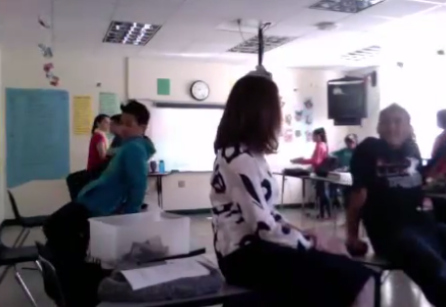
TPR April 10We spent a few minutes doing some Total Physical Response exercises to act out the target words.  Note: middle schoolers like sitting "on top of" their desks.

I printed out and laminated about twenty common prepositions, especially those used in the songs they told me they liked.  I also laminated a picture of John Legend and one of Shakira, allowing students to use these pictures to employ some of the prepositions they knew. "Shakira is on the desk; Shakira is under the desk; John Legend is between Ali and Victoria (pseudonyms)."

That gave me a good idea of their grasp of the concept. The next activity involved a simple "word hunt" wherein partners looked through the lyrics of songs I printed out and found the prepositions.  Again, I had the words on display, with picture supports, and they had already acted out several of them in the TPR part of the lesson.

I had a few of them share their discoveries and, to my delight, they all really did their work and some felt comfortable enough to sing the parts of the songs they found.  The next step was creation.  They voted and decided they wanted to write a song about Shakira instead of John Legend, to my dismay.  I asked them to partner up again, to come choose three of the laminated prepositions I brought and one or two magazine pictures that I cut out to serve as inspiration for their song.  They were to use the pictures and the prepositions to write part of a song "that we were going to create together," though that didn't actually happen. Rhyming and song-writing are for a different day...

Over all, it was a successful lesson. The students shared their work and a lot of it was really insightful. They were able to use the prepositions in literal and figurative manners, which made my English major heart flutter.  My CI and the TA both said how successful they thought the lesson was and one of the toughest cookies in the room kept asking if "we can do this everyday."  That is particularly touching to me because one of his biggest struggles is writing.

I was meant to be an ESOL teacher.  I'm still learning how to climb this mountain and how best to approach these challenges, but man, do I love it in the meantime!

Thursday, March 6, 2014

Arvind Gupta: Turning trash into toys for learning


Brilliant, simple, and inexpensive hands-on toys that will help students understand concrete math and science concepts. I first watched this video a year ago and I continue to love watching his creativity.

Wednesday, March 5, 2014

Learn your roots

I love learning about the history of the English language...

Tuesday, March 4, 2014

Anglophile, revisited

A monster encouraged me to major in English.

Beowulf was my gateway drug into loving linguistics, the English language, and teaching English.  I'm still unclear about why I loved reading that text, learning a little Old English, and getting an introductory to the OED (all standard procedure for exploring the creepy underworld of the famous story). It fueled the fire of my Anglophilia, already growing in my teenage brain. It sealed my decision to major in English and spend all day reading books and discussing complex literary topics in college.

Image courtesy of [papaija2008] / FreeDigitalPhotos.net
Image courtesy of papaija2008 / FreeDigitalPhotos.net
After a stint using my English degree to write tweets and Facebook posts all day for a living, I returned to the academic world to learn how to teach tiny people. I met the monster again in the pages of the textbooks for literacy and teaching English Language Learners. "Muhahahaha!" he growled, "Sárcwide mec þín brægen" {give me your brain}. I love this so much that I'm reminded of how reading about the foundation of our Modern English inspired me to dig deeper into literary themes.

My chronic curiosity inspires me to learn more about how to teach these kiddos. Today I realized that this chronic curiosity might land me in Great Britain again in the future. Perhaps I'll have the opportunity to visit Ireland or England for one of the many conferences and seminars they hold on the topic of teaching English as a second language. Check it out!

Monday, March 3, 2014

Classroom Routines, Vol. 1

Pinterest has both helped and overwhelmed my brain. I have more than 2,100 pins that I truly believe I will look through. Good grief, I'm a nutcase.

Image courtesy of [KROMKRATHOG] / FreeDigitalPhotos.net
As I read my SIOP book by Jana Echevarria, MaryEllen Vogt, and Deborah J. Short, I realize there are so many in-classroom techniques that I will simply never remember to implement or try in my future classroom if I don't make a list! Lists, lists! My kingdom for a list!

These routines and techniques come from "Making Content Comprehensible for English Language Learners: The SIOP Model." In paraphrasing their words, I intend only to make note of the great ideas and not to infringe on any copyrights. These are the ideas of the lovely ladies listed above, not my own (unless otherwise noted):

  • More than jotting down objectives:

    • Get students to practice (and to make emotional connections) by asking them to find and circle the nouns and verbs (or --Elizabeth's idea-- words that rhyme with another word they've already heard today, like "journal" and "infernal" -- :-P )

    • Students paraphrase steps

    • Timed Pair-Share to predict what they might do in the lesson

  • Self-Assess:

    • 1, 2, 3 - How well do you know what's going on? "1. I understand this concept, 2. I have studied something like this before, 3. I don't know this"

      • At the end, follow it up with a "How well did you meet the objective today?" self-assessment

  • Jigsaw it:

    • This is an instructional model that encourages students to become "experts" about a given vocabulary word, topic, person of importance, etc. Students have to teach each other about what they learned, as they're all experts about different things. Many hands/brains make light work.

  • Outline it:

    • If you're a general education teacher (as opposed to an ESOL teacher), consider giving your ELLs a breakdown outline of what you're teaching for each lesson or for each day. You're probably already creating this outline for yourself, so print off another one and give it to your ELL. He or she will be able to better understand what is going on if they have a map of it!

  • Let them hear it:

    • Many sites have audio or video support tools for their content. Let students hear or watch supplementary tools to support their learning. No, I don't think technology is always the answer, especially if your students are easily distracted, but if you can show them you trust them to stay on task while scaffolding their learning, this is a good option.