For me, it has been about a month and the fire has only built up since then.

Showing posts with label ESOL. Show all posts
Showing posts with label ESOL. Show all posts
Friday, November 4, 2016
ExC-ELL: Instructional Obsession
When was the last time you felt like exploding because of a new instructional practice?

Saturday, August 29, 2015
ESOL lesson planner book
There are so few resources out there for ESOL/ESL/EFL teachers to organize their teaching lives. Our schedules are far different from those of a classroom teacher and our materials need to be customized to that difference.
I created a PDF of what I currently plan to use as my paper lesson planner. I do my more in-depth planning on Chalk.com's Planboard because it gives my clickable links, places to embed photos, and easy access to relevant documents. However, I still need a quick glance reference in paper form and the typical classroom teacher planners do not cut it.
I plan to use this PDF (feel free to download) to create a spiral bound notebook-style planner for the 2015-2016 school year. Please enjoy and give me feedback!
I created a PDF of what I currently plan to use as my paper lesson planner. I do my more in-depth planning on Chalk.com's Planboard because it gives my clickable links, places to embed photos, and easy access to relevant documents. However, I still need a quick glance reference in paper form and the typical classroom teacher planners do not cut it.
 |
| This is the layout of the file. The spiral would bind the two halves together. |
Tuesday, August 4, 2015
Silly Mrs. O
How on Earth did I think I would be able to document my first year through a blog?
Throughout the year, about 75% of the nights were devoted entirely to my students. I woke up by 3:30 am at least one time each week because my mind was racing in buzzing loops around all of things I wanted to do to better my students' education. Multiple new speakers arrived at willy nilly intervals at each of my three schools. One of my schools became so over-populated by ELLs that my amazing, compassionate, driving, and leader extraordinaire principal convinced the ESOL department and central office to reallocate my time so that I spent the last half of the year serving her school more hours each week, dropping my third school.

I realized I would be earning at least one new master's degree every year of teaching, by virtue of the research I conducted to improve my instruction. I felt like I was swimming in a miles-long ocean race, remaining just above the chopping waves, looking out toward the shore to make sure I could still make it back.
But I made it. At some point, and it's hard to distinguish exactly when that happened, guided reading became more routine. I became more confident in my ability to diagnose a need and use evidence-based practice without feeling compelled to spend all weekend researching for one child. Instead, I was able to quickly research for a dozen of my kids!
I'm grateful and joy-filled to share that my life of teaching ELL students is exactly what I should be doing. I was meant to do this. I get to honestly share the envy-inducing small talk statement, "I love my job!"
Sunday, August 10, 2014
My new favorite word: Interpunct
As I'm working on building a curriculum for vocabulary, most especially around morpheme analysis and word sums by WordWorksKingston, I'm thinking way too hard about the little things. I would love some feedback from any SLA experts, ESOL teachers, or general classroom teachers out there who can shed some light on my question:
Do the hyphens used to end or begin a prefix or suffix confuse your students?
Thinking about this like an eight-year-old, which is not much different than thinking about it like the adult I am, learning this in depth for the first time, I see the hypen as a subtraction symbol. How is an eight-year-old without a significant number of words to communicate their confusion supposed to know inherently that they are meant to add that suffix to the stem, not subtract it, when this is the first time they have seen morpheme analysis.
Unless someone stops me, I have half a mind to use an interpunct (·) in lieu of the hyphen. Instead of de-, students will see de·. It makes sense to me that we should use the same symbol used to separate syllables to separate affixes from stems, as they are also the place where will break up the word between syllables.
De·tail·ing
De·:“to pull away”, “away, off"
·Tail·: coming from a French word meaning "to cut"
·Ing: progressive/continuous
 |
| All I had to do was search "etymology detail" and Google did the work for me |
When you are detailing something, you are considering something cut away from the rest of the original, larger picture. As Gus said in My Big Fat Greek Wedding, "So der you go."
Again, perhaps I'm over-thinking this, but removing the hyphens prevents eight-year-old ELL-me from thinking about subtraction and allows me to make the connection to syllabification.
What do you think? I would love some insight on this. Tell me if I've "discovered" something that was A) never really a problem or B) is already a topic of discussion in SLA research.
Wednesday, July 16, 2014
Part-Time Librarian
It's becoming real! Fall is approaching, though I'm not wishing my summer away, and I'm hunkering down in my classroom planning work. Today, that looks like multiple stacks of old, inherited books and an evolving Excel spreadsheet.

Having an Android phone, apparently, limits my book cataloging app-pickin's, so I started off manually typing every book into a spreadsheet. As expected, there's an easier way.
Scholastic's Book Wizard (love that little guy) has a book list tool that aggregates the books you pick (including their levels, interest information, and other key necessities for classroom libraries) and allows you to download it as an Excel file. I will still fiddle with the final list, organizing and adding categories to help my kiddos.
The process continues to evolve! There's so much hope packed into this process.
...I fully accept my romanticizing of this, by the way.
Friday, July 11, 2014
Class set-up for ESOL teachers
 |
| Image courtesy of phasinphoto / FreeDigitalPhotos.net |
As I'm preparing for my new classroom, this is going to be a helpful resource for thinking ahead. Organization Monster is starting to growl from within and I gotta say: there is a severe lack of attention to ESOL/ESL-specific classroom set-up in the blogosphere.
I might have to change that.
Saturday, April 12, 2014
But I know where to start
Ahh! Grammar! I know, and you, fair reader, probably know, that teaching grammar directly, especially to English language learners is a somewhat fruitless endeavor. The SLA king, Dr. Stephen Krashen, and many others have refined the concepts that essentially discourage direct instruction of grammar, both because it is largely less effective than natural acquisition of grammar through exposure and because it discourages students to produce language. Hearken back to the days of old -- that high school Spanish classroom where you stared at half a dozen conjugation charts and fought the would-be urge to participate because you couldn't keep all of the rules straight enough to avoid making a mistake!
As a (probably conditioned) supporter of these natural order SLA theories, I hesitated to construct a lesson for my practicum this week. My cooperating instructor suggested I teach a lesson about prepositions (quick Google search to remind myself about this grammar concept that someone labeled) because many of the newcomer students in the classroom had been running into vocabulary blockages when they spoke and wrote. Challenge accepted. I knew I could use my background knowledge of the newcomer middle schoolers in the classroom and make an engaging lesson.
Background knowledge: I have been working with these students since January and I've noticed some gaps in their use of prepositions (under, on, in, over, around, etc). In preparation for my lesson and in an effort to highlight student choice, I asked them about their favorite English songs. That was a fun few minutes where these students who constantly have a huge cognitive language load weighing on them got to relax for a moment and engage with their teachers about what they enjoy.
The lesson: I started the lesson by playing the first verse of Avicii's "Wake Me Up." Listen to the lyrics and let it blow your mind to discover: it's about prepositions ( ;) ). We have to know where to start, I told them. We were going to talk about, read about, speak about, and listen about words we use to tell people WHERE something is.
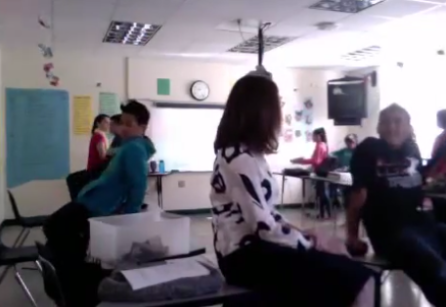 We spent a few minutes doing some Total Physical Response exercises to act out the target words. Note: middle schoolers like sitting "on top of" their desks.
I printed out and laminated about twenty common prepositions, especially those used in the songs they told me they liked. I also laminated a picture of John Legend and one of Shakira, allowing students to use these pictures to employ some of the prepositions they knew. "Shakira is on the desk; Shakira is under the desk; John Legend is between Ali and Victoria (pseudonyms)."
That gave me a good idea of their grasp of the concept. The next activity involved a simple "word hunt" wherein partners looked through the lyrics of songs I printed out and found the prepositions. Again, I had the words on display, with picture supports, and they had already acted out several of them in the TPR part of the lesson.
I had a few of them share their discoveries and, to my delight, they all really did their work and some felt comfortable enough to sing the parts of the songs they found. The next step was creation. They voted and decided they wanted to write a song about Shakira instead of John Legend, to my dismay. I asked them to partner up again, to come choose three of the laminated prepositions I brought and one or two magazine pictures that I cut out to serve as inspiration for their song. They were to use the pictures and the prepositions to write part of a song "that we were going to create together," though that didn't actually happen. Rhyming and song-writing are for a different day...
Over all, it was a successful lesson. The students shared their work and a lot of it was really insightful. They were able to use the prepositions in literal and figurative manners, which made my English major heart flutter. My CI and the TA both said how successful they thought the lesson was and one of the toughest cookies in the room kept asking if "we can do this everyday." That is particularly touching to me because one of his biggest struggles is writing.
I was meant to be an ESOL teacher. I'm still learning how to climb this mountain and how best to approach these challenges, but man, do I love it in the meantime!
As a (probably conditioned) supporter of these natural order SLA theories, I hesitated to construct a lesson for my practicum this week. My cooperating instructor suggested I teach a lesson about prepositions (quick Google search to remind myself about this grammar concept that someone labeled) because many of the newcomer students in the classroom had been running into vocabulary blockages when they spoke and wrote. Challenge accepted. I knew I could use my background knowledge of the newcomer middle schoolers in the classroom and make an engaging lesson.
Background knowledge: I have been working with these students since January and I've noticed some gaps in their use of prepositions (under, on, in, over, around, etc). In preparation for my lesson and in an effort to highlight student choice, I asked them about their favorite English songs. That was a fun few minutes where these students who constantly have a huge cognitive language load weighing on them got to relax for a moment and engage with their teachers about what they enjoy.
The lesson: I started the lesson by playing the first verse of Avicii's "Wake Me Up." Listen to the lyrics and let it blow your mind to discover: it's about prepositions ( ;) ). We have to know where to start, I told them. We were going to talk about, read about, speak about, and listen about words we use to tell people WHERE something is.
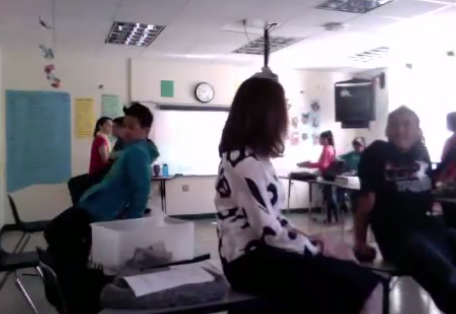 We spent a few minutes doing some Total Physical Response exercises to act out the target words. Note: middle schoolers like sitting "on top of" their desks.
I printed out and laminated about twenty common prepositions, especially those used in the songs they told me they liked. I also laminated a picture of John Legend and one of Shakira, allowing students to use these pictures to employ some of the prepositions they knew. "Shakira is on the desk; Shakira is under the desk; John Legend is between Ali and Victoria (pseudonyms)."
That gave me a good idea of their grasp of the concept. The next activity involved a simple "word hunt" wherein partners looked through the lyrics of songs I printed out and found the prepositions. Again, I had the words on display, with picture supports, and they had already acted out several of them in the TPR part of the lesson.
I had a few of them share their discoveries and, to my delight, they all really did their work and some felt comfortable enough to sing the parts of the songs they found. The next step was creation. They voted and decided they wanted to write a song about Shakira instead of John Legend, to my dismay. I asked them to partner up again, to come choose three of the laminated prepositions I brought and one or two magazine pictures that I cut out to serve as inspiration for their song. They were to use the pictures and the prepositions to write part of a song "that we were going to create together," though that didn't actually happen. Rhyming and song-writing are for a different day...
Over all, it was a successful lesson. The students shared their work and a lot of it was really insightful. They were able to use the prepositions in literal and figurative manners, which made my English major heart flutter. My CI and the TA both said how successful they thought the lesson was and one of the toughest cookies in the room kept asking if "we can do this everyday." That is particularly touching to me because one of his biggest struggles is writing.
I was meant to be an ESOL teacher. I'm still learning how to climb this mountain and how best to approach these challenges, but man, do I love it in the meantime!
Subscribe to:
Posts (Atom)